

【KABUKI Miscellany】 Episode 15 : The Colors of Kabuki – Asagi Blue / Narrated by Tateo Okido
Hello! We are Asanoha, a tenugui specialty shop located in AzabuJuban, Tokyo.
We’re delighted to share a collection of intriguing stories related to Kabuki. These tales are narrated by Mr. Tateo Okido, an expert in Kabuki and the artist behind the original designs of our Kabuki-themed tenugui. Please enjoy this special series, Kabuki Miscellany, presented by Mr. Okido.
Kabuki Miscellany – Episode 15 : The Colors of Kabuki – Asagi Blue
Japanese theaters are home to a wide variety of curtains — hikimaku (draw curtains), donchō (front curtains), agemaku (backstage curtains), and asagimaku (asagi-blue curtains). These fabric dividers separate stage and audience, or backstage and stage. Historically, traditional Japanese performing arts like noh and kyōgen had backstage curtains, but early kabuki did not have a curtain separating audience and stage. In those days, each performance was a self-contained act, and there was no need to mark the boundaries with curtains.
This began to change in 1664 (Kanbun 4), when serialized kabuki plays started appearing in both Edo and Kamigata (Kyoto-Osaka). With the rise of multi-act productions, stage curtains became essential both for transitions and theatrical effect. While Western theater uses front curtains that open vertically, kabuki traditionally employs hikimaku that open horizontally. The vertical donchō was first introduced at Tokyo’s Shintomi-za Theater in 1879, but even today, it’s mainly reserved for shingeki-inspired works or certain stylized dance pieces (matsubamemono).
There are many types of kabuki curtains: single-piece hikimaku, two-part versions used in Kamigata-style Kanadehon Chūshingura, gifted curtains for actor name-succession events, dōgu-maku with scenic designs (waves, mountains), black curtains, asagimaku, and gauze-like shamaku.
Among them, the asagimaku holds a special place. Dyed in a pale bluish-green — known as asagi — this curtain is used for the spectacular stage effect called furiotoshi, where the curtain is dropped in an instant to reveal a dramatic scene. A rod above the stage holds the curtain in place, and with a sudden pull of the stopper, the entire cloth drops away. In a flash, the audience is plunged into the vibrant world of kabuki, with actors standing poised in bold mie poses — it’s a breathtaking transformation.
A famous example is the scene from Yoshitsune Senbonzakura where Shizuka Gozen and Tadanobu stand beneath a canopy of cherry blossoms. When the asagimaku falls, the visual impact is immediate and unforgettable. Sometimes, before the main scene begins, there’s even a short play performed in front of the curtain — known as asagi-mae. In Musume Dōjōji, for instance, monks enter from the hanamichi, discussing a ritual and planning a drunken feast — a delightful prelude. For a name-succession event, these monks may be played by senior actors, making the scene even more special. Once they exit, the asagimaku drops, revealing the full stage in all its glory — this moment is the very essence of kabuki magic.
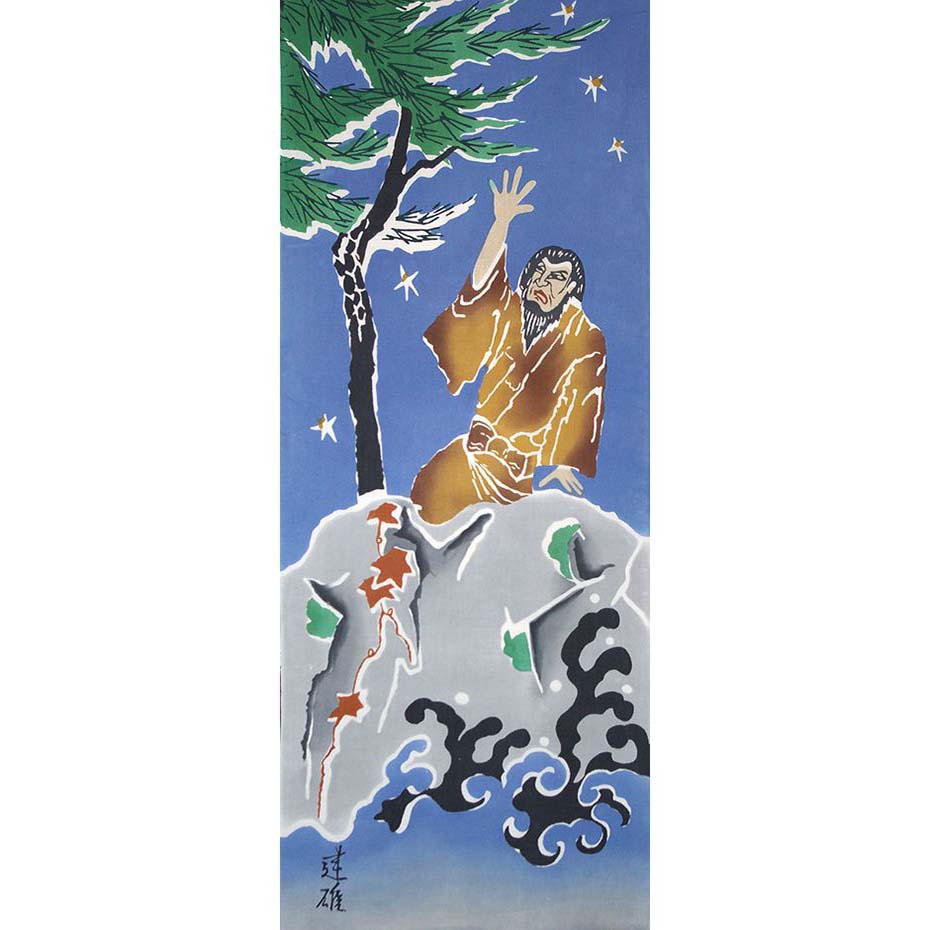
But the asagimaku isn’t only used for dazzling, celebratory scenes. It also serves to set a somber tone. In Act V of Kanadehon Chūshingura, during the “Teppō-watashi” (Gun Transfer) scene, the curtain falls to reveal Kanpei sitting beneath a pine tree. His face hidden beneath a straw hat, Kanpei lifts his head, revealing his pale, painted visage glowing in the dark — a haunting effect. Everything in kabuki — its stagecraft, direction, and acting — is designed to captivate and move the audience.
Asagi is not just a color for curtains. It also appears in costumes, especially for youthful male roles (iro-wakashu) filled with melancholy, sensuality, or tragic fate — characters like Sakuramaru in Sugawara Denju Tenarai Kagami, Shirai Gonpachi in Suzu-ga-mori, or Kanpei himself. The pale blue-green evokes emotion and foreshadows death. Even the famous haori jackets of the Shinsengumi were dyed asagi, reinforcing the color’s association with honor, melancholy, and mortality.
Asagi is a color shaped by four centuries of classical theatrical tradition — a true reflection of the Japanese sense of color, and of the depth and emotion at the heart of kabuki.